When Your Apple Watch Says You're Stressed
Your Apple Watch says you're stressed. You feel fine. The gap between the reading and the feeling is where the real information lives.

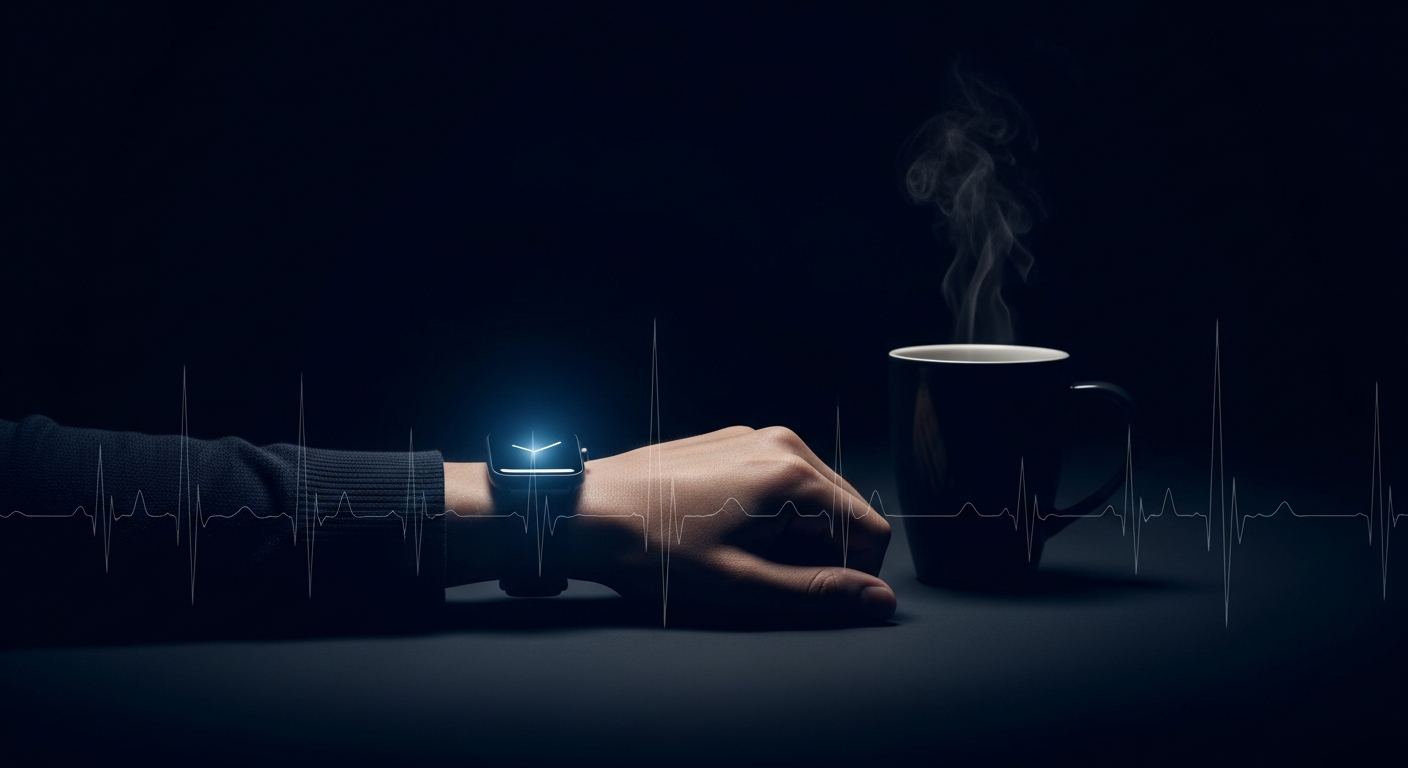
The watch buzzed on an ordinary Tuesday morning. A high stress reading. I was standing in my kitchen holding a coffee, feeling nothing except mild impatience with the toaster.
There's a small indignation in that moment. When your Apple Watch says you're stressed and you feel fine, the first instinct is to argue with it. No I'm not.
I'd slept fine. The morning was quiet. The reading felt like being accused of something.
So I dismissed the alert and went on with my morning. By two in the afternoon I was short with someone I like and rereading the same email for the fourth time.
The watch hadn't been wrong. It had been early.
Your Apple Watch Says You're Stressed. You Feel Fine.
The gap between what the watch reads and what you feel has two possible explanations, and neither one is comfortable.
Either the sensor misread something, or your body is doing something you can't feel yet. The first explanation questions the device. The second questions you.
For high performers, the second one lands harder than it should. If you spend your days performing steadiness, "I feel fine" is a professional skill. You've rehearsed it. Being told otherwise, by a watch, lands somewhere between silly and unsettling.
Search the phrase "apple watch says I'm stressed" and you'll find both camps. Half the posts are people deciding their watch is broken. The other half are people quietly asking whether something is wrong with them.
Neither camp is wrong to wonder. Sensors do misread, and bodies do carry load without telling you. That's what makes the moment sticky: both explanations are live.
Most of us resolve the discomfort a third way: close the notification, move on. I did that for months.
The accuracy question is real, and worth taking seriously. Wearable stress readings are estimates built largely on heart rate variability, or HRV: the tiny changes in timing between one heartbeat and the next.
I've written before about how much a wearable stress score misses. That piece is about the metric.
This one is about the moment. Standing in a kitchen, feeling fine, holding a reading that says otherwise.
Here's where I've landed after two years of building in this space: the reading and the feeling can both be true. They're measuring different things, on two different clocks.
The Feeling Is the Last Thing to Arrive
Stress shows up in the body before it shows up in awareness. Heart rate shifts, HRV drops, breathing goes shallow, and all of it is measurable before you would describe yourself as stressed.
Researchers who study this put it plainly: the body's stress response starts first, and the conscious feeling follows. Sometimes minutes later. Sometimes hours.
The feeling arrives like a summary your mind writes afterward, from whatever attention it has left over. On a packed day, there's nothing left over.
Your laptop works the same way. The fan spins up before anything on screen looks slow, because load arrives before symptoms do. Nobody argues with the fan.
You've felt this in reverse. You snap at someone in a 4pm meeting, and only afterward realize you'd been wound tight since lunch.
The stress didn't begin when you noticed it. That was the moment awareness caught up.
Your body files the report hours before you read it.
Look back over a mapped day and the pattern is common. The physiological spike stamps itself mid-morning. The words for it show up mid-afternoon.
So a reading you can't feel isn't automatically a contradiction. The watch is reading physiology while you're reading feelings, and the feeling runs late.
That's what my Tuesday alert turned out to be. The load was building by breakfast. I met it at two.
Sometimes Your Apple Watch Says You're Stressed, and It's Coffee
Sometimes there's no hidden stress at all. The reading is coffee.
Caffeine raises heart rate and lowers HRV. So does a flight of stairs, a hot room, a heavy lunch, a short night of sleep, a cold that hasn't announced itself yet. To a wrist sensor, keyed-up and anxious look nearly identical.
The sensor reads arousal. It has no idea what the arousal means.
It can measure the timing of your heartbeat down to the millisecond, and it doesn't know you carried groceries up four flights. Ricky has written a longer piece on what Apple Watch can and can't detect; the short version is that the hardware reads physiology well and knows nothing about your circumstances.
It cuts the other way too. Good news raises your heart rate. So does a pitch that's going well.
The same physiology sits under dread and excitement, and the sensor can't split them. The forums are full of a stranger version: "my watch flagged stress while I was on the couch watching a movie." A thriller raises heart rate too... the sensor logged arousal, and the meaning was the plot.
So the honest answer to "was that a false positive?" is: the watch alone can't tell you. Context decides what the number means. The same reading means nothing in the hour after an espresso, and quite a lot in the quiet hour before a board meeting.
What to Do With a Reading You Can't Feel
Treat a reading you can't feel as a lead worth ten seconds of your attention.
Arguing with it forces you to pick a side: stressed or fine, watch or body. Following it asks a quieter question instead... is anything going on?
The ten seconds look like this: coffee in the last hour, a flight of stairs, a hot room, a short night?
If something explains the reading, close the notification without a second thought. No guilt, no spiral.
If nothing explains it, take the lead seriously. Not with anything dramatic — two minutes of slower breathing, a walk to the window, a pause before you open the next thing. Small moves work when the spike hasn't compounded yet.
Two minutes is the honest unit here. A spike met early needs minutes; the same spike found at 4pm can take the evening.
The asymmetry is what convinced me to keep running the scan. Honoring a lead that turns out to be nothing costs two minutes. Dismissing one that turns out to be real costs the afternoon, and sometimes the people in it.
This is also why we built Momomoon the way we did. A raw number on your wrist leaves that ten-second scan to you, every time, forever. So we made the system run it instead: Momomoon reads the signal alongside your calendar, your patterns, and the hour of your day, and when the read is real it acts — a nudge on your wrist, a 90-second haptic reset before the spike compounds.
The argument with the wrist mostly disappears when the reading arrives with its context attached. If you want the mechanics, here's how Apple Watch stress detection works.
I think about that Tuesday alert differently now. The watch wasn't accusing me of anything. It noticed something before I could, and asked, in effect: anything going on?
Feeling fine is real information. So is the reading. The skill is holding both at once, without arguing for either side.
PS: I still argue with the watch some mornings. Old habit. But I run the ten seconds first now.
Momomoon is the intelligence layer for your nervous system. It reads HRV and context signals from your Apple Watch, notices rising stress, and steps in with a 1–2 minute reset — before your day tips over. Free to download, and your first month of Momo is included.
Get new Journal entries when they’re published.
Field notes from the build. No marketing.